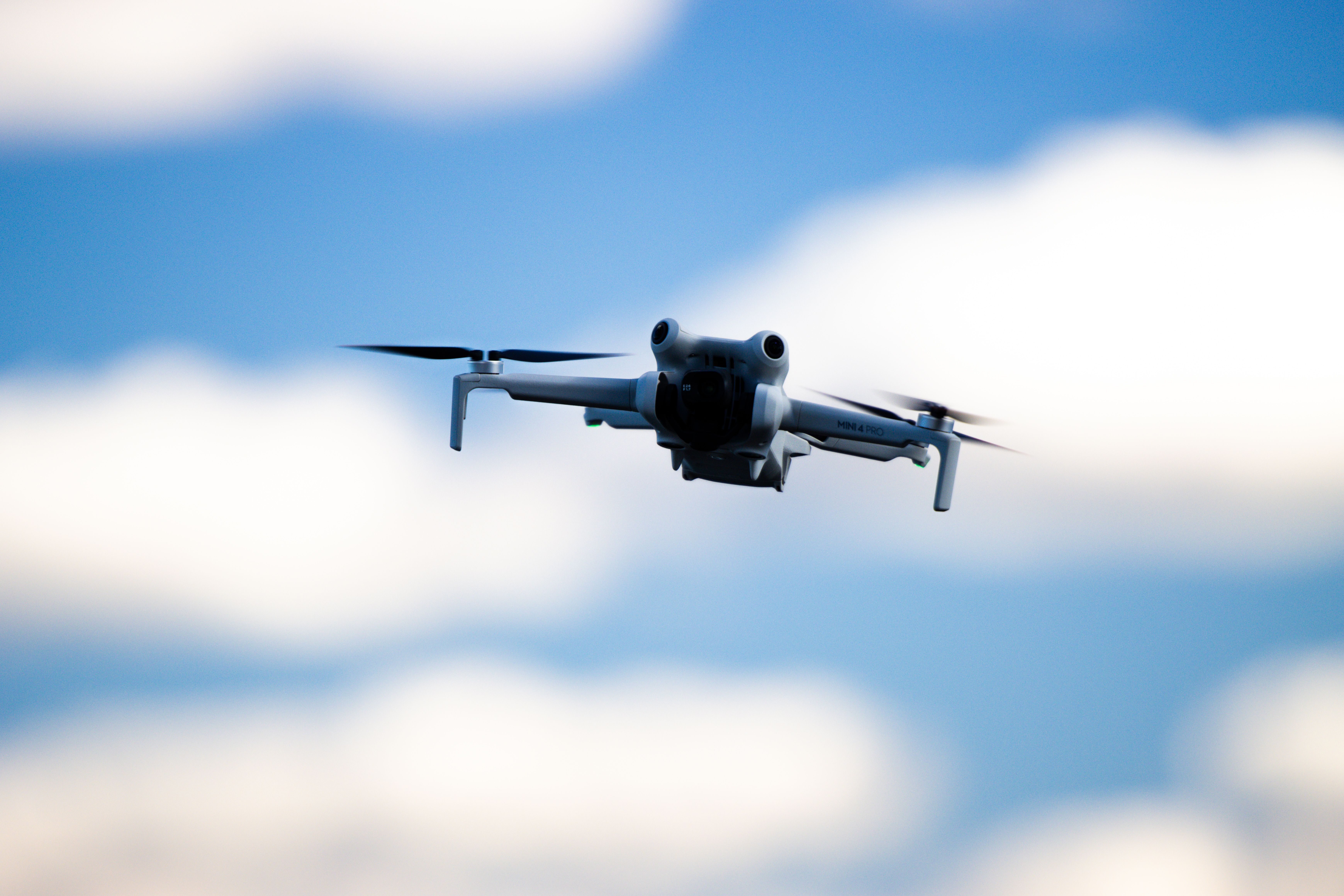
Detect and Avoid, usually abbreviated as DAA, is one of the most important technologies for integrating unmanned aircraft into shared airspace. Its purpose is to give a drone operation the ability to detect other airspace users, understand whether they represent a conflict, and take action early enough to remain safely separated.
DAA is especially important for Beyond Visual Line of Sight operations. When a drone flies beyond the area in which the remote pilot can directly observe the surrounding airspace, the operation can no longer rely only on human vision. Another safety layer is needed to support or replace the traditional aviation principle of see and avoid.
DAA is more than a sensor
Detect and Avoid is sometimes described as if it were a camera, radar or receiver installed on a drone. In reality, it is a complete operational function. A sensor may detect an aircraft, but detection alone does not prevent a collision.
A complete DAA chain normally needs to perform several connected tasks:
- detect another airspace user;
- establish and maintain a reliable track;
- estimate relative position, altitude, speed and direction;
- assess whether the encounter may become hazardous;
- select an appropriate avoidance action;
- communicate or execute that action;
- confirm that the conflict has been resolved; and
- return the aircraft safely to its planned operation.
The performance of the whole chain matters. A high-quality sensor is of limited value if the system processes the data too slowly, creates unreliable tracks or recommends an avoidance manoeuvre too late.
Cooperative and non-cooperative traffic
One of the central challenges for DAA is that not every aircraft is visible in the same way. Cooperative aircraft intentionally transmit information that can be received by other systems. Depending on the airspace and equipment, this information may come from technologies such as ADS-B, Mode S, FLARM, Electronic Conspicuity devices or network-based traffic services.
Cooperative surveillance can provide accurate identity, position, altitude and velocity information. It is therefore highly useful for building a traffic picture. However, it cannot be assumed that every aircraft will be transmitting compatible or valid information.
Non-cooperative traffic does not provide a usable electronic transmission to the DAA system. Detecting it may require radar, electro-optical cameras, infrared sensors, acoustic systems or a combination of technologies. Birds, balloons, gliders, aircraft without compatible equipment and aircraft with malfunctioning transmitters may all create non-cooperative detection challenges.
A mature DAA architecture therefore cannot depend blindly on a single data source. It must understand the limits of its surveillance environment and manage situations in which traffic is only partly visible.
Airborne, ground-based and hybrid DAA
DAA can be implemented in several architectural forms. An airborne system places sensors and processing equipment on the unmanned aircraft. This can give the aircraft a high degree of independence from external infrastructure and allow it to detect traffic along its route.
The disadvantage is size, weight, power consumption and cost. Small drones may not be able to carry aviation-grade radar, multiple cameras and the processing hardware needed to interpret their data.
A ground-based DAA system uses sensors positioned on the ground. One radar or sensor network may observe a corridor, industrial site, airport environment or defined operating area. Traffic information is then transmitted to the remote pilot station or directly to the UAS control system.
Ground-based DAA can be effective for repeated operations in a known area, but its coverage is limited by terrain, buildings, sensor placement, communications and the geometry of the operating volume.
A hybrid architecture combines airborne, ground and network-based sources. For many commercial BVLOS operations, this may become the most realistic solution. Each source covers different limitations, while data fusion creates a more complete traffic picture.
Detection must happen early enough
The critical question is not simply whether another aircraft can be detected. It is whether it can be detected early enough. A DAA system needs sufficient time to establish a track, evaluate the encounter, alert the remote pilot or flight-control system, execute an avoidance manoeuvre and restore safe separation.
This creates the concept of a detection volume. The required volume depends on the speed of the drone, the speed of potential intruders, closure rates, manoeuvrability, communications latency and the time needed by a human or automated system to respond.
A slow multirotor operating close to an industrial site will have different requirements from a large fixed-wing UAS flying long-distance routes. There is therefore no universal detection range suitable for every operation.
Strategic and tactical mitigation
DAA should not be viewed as the only defence against collision. Air risk is normally managed through several layers.
Strategic mitigation reduces the probability of an encounter before the flight begins. It may include choosing a low-traffic operating area, flying at a suitable time, using defined corridors, coordinating with an air navigation service provider, publishing relevant information or applying airspace restrictions.
Tactical mitigation acts when traffic is encountered during the operation. This is where DAA, airspace observers, traffic information services and avoidance procedures become important.
A strong operation combines both layers. It first reduces the likelihood of encountering other aircraft and then provides a credible method for responding if an encounter still occurs.
DAA and the SORA process
Within the European specific category, the Specific Operations Risk Assessment provides a structured way to assess ground and air risk. The air-risk part considers how likely the unmanned aircraft is to encounter manned aviation and which strategic or tactical mitigations are needed.
The required Tactical Mitigation Performance Requirement depends on the residual air risk. A relatively simple operation in airspace with very little manned traffic may rely on procedures, observers or basic traffic information. A more demanding operation may require a DAA solution with stronger performance evidence, reliability and assurance.
This is an important principle: DAA requirements should be proportional to the operation. A system designed for a rural inspection route does not necessarily need the same architecture as a system intended for high-density operations near controlled airspace.
Remaining well clear versus last-second collision avoidance
DAA should ideally act before an encounter becomes an emergency. The objective is usually to remain well clear of other aircraft, not to wait until a collision is only seconds away.
Remaining well clear gives the system time to use predictable and moderate manoeuvres. It also reduces surprise for pilots of manned aircraft and allows the drone to return to its authorised route in a controlled manner.
Collision avoidance is the final protective layer. It addresses an immediate threat when normal separation has already been compromised. Systems that operate only at this stage may need very fast sensors, highly reliable automation and aggressive manoeuvring authority.
A scalable BVLOS system should therefore distinguish traffic awareness, conflict detection, remain-well-clear action and emergency collision avoidance.
The role of the remote pilot
Not every DAA system is fully autonomous. In many operations, the technology detects and tracks traffic, while the remote pilot decides whether and how to manoeuvre. This keeps the human in the decision loop, but it creates requirements for alert design, training, workload management and communications reliability.
The remote pilot must understand what the display shows, which traffic may be missing, how old the data is and what procedures apply when the system becomes unavailable. Alerts must be clear enough to support rapid action without creating excessive nuisance warnings.
Where the UAS automatically executes an avoidance manoeuvre, responsibilities still need to be clearly defined. The operator must understand when automation can intervene, how it prioritises different threats and how control is returned to the planned flight.
Communications are part of DAA
A ground-based or pilot-mediated system depends on the command-and-control link. Even perfect surveillance information may be ineffective if it cannot reach the pilot or aircraft in time.
Latency, packet loss, coverage gaps and link interruptions must therefore be included in the safety assessment. The operation also needs predefined behaviour for degraded conditions. The aircraft may need to slow down, hold position, move to a safer altitude, follow a contingency route or terminate the flight.
DAA and C2 should not be assessed as separate technologies when they depend on each other to complete the avoidance function.
How U-space can support DAA
U-space services can add valuable information to the DAA picture. Network identification, traffic information, flight authorisation and shared operational intent can reduce uncertainty and help identify potential conflicts before aircraft come close to each other.
However, U-space traffic information is not automatically equivalent to a complete DAA system. The information may depend on electronic conspicuity, surveillance coverage and communications availability. Non-cooperative traffic may still be missing.
The strongest future architecture is likely to combine U-space information with onboard or ground-based sensing and well-defined operational procedures.
The role of AI
Artificial intelligence can support the detection and classification of non-cooperative traffic, especially when cameras or multiple sensors are used. It can help distinguish aircraft from clouds, birds, buildings or background noise and can improve the prediction of possible trajectories.
AI may also help rank threats and reduce unnecessary alerts. But the use of AI introduces questions about training data, edge cases, explainability and predictable behaviour. Aviation needs evidence that the system performs safely not only in normal conditions, but also when visibility, weather, lighting or sensor quality deteriorates.
The more authority an AI system receives to select and execute manoeuvres, the stronger the assurance and validation expectations will become.
Proving that DAA works
The biggest challenge is not demonstrating one successful test flight. It is showing that the system provides dependable performance across the complete operational environment.
Evidence may need to address detection probability, false alarms, track accuracy, surveillance coverage, communications delay, environmental limitations, software behaviour, sensor failures, human response and contingency procedures.
Testing should include realistic encounter geometries, different aircraft types, difficult backgrounds, low visibility, unexpected manoeuvres and partial system failures. The final safety case must describe both the capability and the limitations of the system.
Conclusion
Detect and Avoid is not one device and not one algorithm. It is a complete safety function connecting surveillance, data processing, decision-making, communications, flight control and operational procedures.
Its importance will grow as BVLOS operations move from isolated demonstrations to recurring commercial services. Infrastructure inspection, logistics, environmental monitoring, emergency response and long-range surveying all depend on a credible way to manage encounters with other airspace users.
For PANKA readers, the key takeaway is that BVLOS scale will not be enabled by range alone. It will be enabled by the ability to understand the surrounding airspace and respond predictably when another aircraft appears. Detect and Avoid is the layer that turns remote flight into integrated aviation.